
Table of Contents
- Why Black History Board Games Belong on Your Family Game Night
- How to Choose the Best Black History Board Games for Your Family
- Black History Games for Kids: What Works for Younger Players
- Black history trivia game options for teens and adults
- Educational Board Games for Families That Teach Financial Literacy
- Black Culture Trivia Cards and Discussion Starters
- Historical Accuracy and Cultural Consultation: What to Verify
- Conclusion
- Frequently Asked Questions
Last Updated: October 7, 2026
Why Black History Board Games Belong on Your Family Game Night
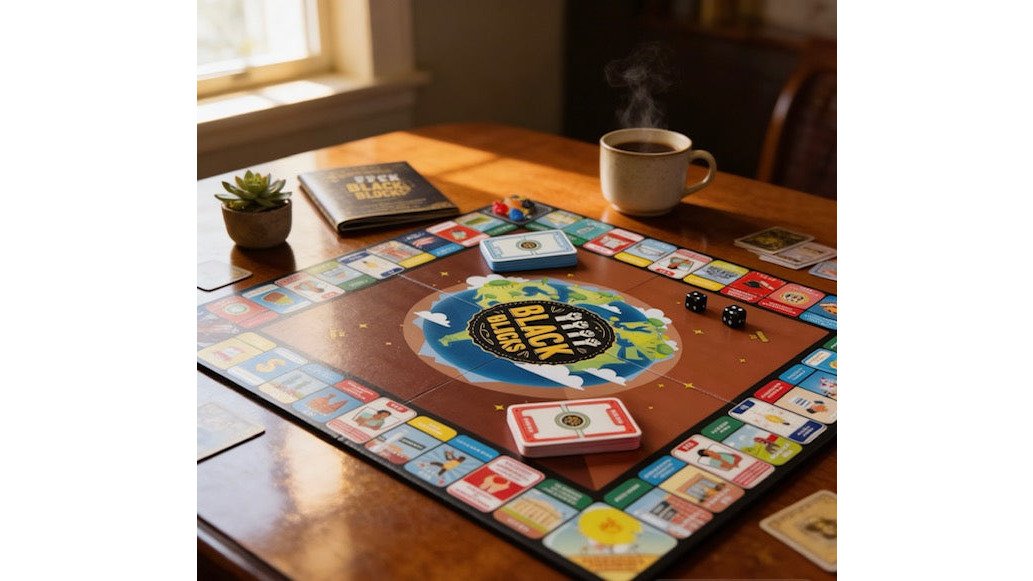
The best Black history board games for families turn a table into a classroom where nobody feels like they're in school. At Black Blocks Game, we built our own game around that idea: culture meets capital, and learning happens while everyone is laughing and competing.

Family game night is already a ritual in many households. Adding a game with historical and cultural substance raises the stakes. Kids absorb names, places, and events through play, and adults often learn something they missed in school.
How to Choose the Best Black History Board Games for Your Family
Most roundups tell you to "check the age range" and stop there. That advice is useless when you're standing in a store aisle or scrolling a product page at 9 p.m. What families actually need is a way to match a specific game to a specific group in under two minutes. Here's the framework, plus the numbers that matter.
The Four Numbers on the Box (and What They Really Mean)
Every family game lists four specs. Read them in this order:
| Spec | What the box says | What it actually means for your table |
|---|---|---|
| Age range | "8+" or "12+" | The minimum age for the rules, not the reading. A game rated 8+ with dense cards still stalls if your 8-year-old reads below grade level. |
| Player count | "2-6 players" | Check the best count, not the range. Many games list 2-6 but play poorly at 2. Look for "best with 4" language in reviews. |
| Play time | "30-60 min" | This is the publisher's estimate for experienced players. Add 15-20 minutes for a first playthrough with kids. |
| Reading level | Rarely listed | The hidden dealbreaker. If cards carry full paragraphs, the game becomes a read-aloud session. Look for short prompts or icon-based play. |
Match the Game to Your Actual Group
A game that fits a homeschool co-op of ten will bore a family of three. Use this quick mapping:
- Two players (parent + child): Look for games with a cooperative mode or a two-player variant. Competitive trivia with only two players turns into a quiz, not a game.
- Three to four players (nuclear family): The sweet spot for most strategy and trivia hybrids. Turns stay short and everyone stays involved.
- Five or more (multigenerational, extended family): Team play or party-style formats work best. Individual-turn games drag past the 90-minute mark and lose younger players.
The Reading-Level Test
Before you buy, find a photo of the game's cards. Then run this test:
- Count the words on a typical card. Under 25 words is family-friendly. Over 50 words means an adult will be reading aloud every turn.
- Check the font size. If you can't read it in a product photo, it's too small for a shared table.
- Look for visual cues, icons, colors, or symbols that convey meaning without reading.
What to Look For Beyond the Specs
The specs get a game to the table. These four factors keep it there:
- Replayability: Does the game have enough cards or scenarios to survive a dozen plays? A trivia game with 200 cards runs out fast.
- Discussion prompts: Cards that ask "why" or "what would you do" extend the game past the win condition and into real conversation.
- Cultural specificity: Named people, places, and events beat vague references every time. "A civil rights leader" is weaker than a specific name and year.
A Note on Price and Value
Family board games in this category typically run from about $20 for a card-based trivia deck to $50 or more for a full board game with components. Price alone doesn't signal quality. A $25 game with cited sources and strong replay value beats a $45 game with vague content and thin components. Factor in how many players it serves and how often it will hit the table, cost per game night is the number that actually matters.
Black History Games for Kids: What Works for Younger Players
Black history games for kids work best when the rules are simple and the learning is built into play, not bolted on. Younger players engage through matching, guessing, and quick trivia rounds, not long reading passages.
Look for these features when shopping for younger children:
- Large, readable cards with short prompts
- Turns that take under a minute
- Bright, clear game pieces
A common mistake is buying a game that's really a quiz in disguise. Kids spot that fast and disengage. The better options blend trivia with strategy, so winning feels like a game, not a test.
Black history trivia game options for teens and adults
A Black history trivia game lands differently with teens and adults because the stakes feel real. This age group wants questions that spark debate, not just right-or-wrong flashcards.
Teens and adults respond to trivia that covers historical events, historical figures, and cultural milestones they can connect to current conversations.
What separates a good trivia night from a forgettable one:
- Questions spread across eras, not just the famous names
- A mix of difficulty so every player scores something
- Discussion prompts after answers, so the game teaches
For groups that want more than trivia, strategy games add a layer where knowledge and decision-making both matter.
Educational Board Games for Families That Teach Financial Literacy
Educational board games for families teach financial literacy best when money decisions carry real consequences inside the game. Players learn about assets, risk, and planning by making choices, not by reading definitions.
Financial literacy is where a game can quietly do serious work. When a player has to decide whether to acquire an asset or hold cash, they're practicing the same reasoning adults use with real money.
Black Blocks Game was built around exactly this combination: strategic gameplay that celebrates Black history while teaching real-world financial literacy. Players acquire assets, navigate market shifts, and build toward a legacy, all within a single game night.
Black Culture Trivia Cards and Discussion Starters
Black culture trivia cards do more than test knowledge. They open conversations that families don't always have, and that's often the real value of the game.
Discussion starters work because they slow the game down just enough for someone to tell a story. A card about a historical figure becomes a moment where a grandparent shares what they remember.
When you're evaluating a game's culture cards, check whether the content:
- Names specific people, places, and events rather than vague references
- Covers a range of eras and regions
- Includes prompts that invite personal reflection, not just facts
For families, these cards often become the part everyone remembers.
Historical Accuracy and Cultural Consultation: What to Verify
This is the section most buying guides skip, and it's the one that separates a game your family will trust from one you'll quietly shelve. A board game about Black history carries a specific responsibility: it can either deepen a child's understanding or reinforce a simplified, flattened version of events. Here's how to tell the difference before you spend money.
Why Accuracy Is a Family Decision, Not Just an Academic One
When a game names a historical figure, a child may repeat that name at dinner, in a school project, or in a conversation with a grandparent. If the game gets the details wrong, a wrong date, a misattributed quote, a movement reduced to a single moment, the error travels with the child. That's the real cost of a poorly researched game.
The Three Levels of Sourcing
Not all sourcing is equal. Here's a practical way to rank what you find:
| Level | What it looks like | What it tells you |
|---|---|---|
| Named sources | Rulebook or website cites specific books, archives, or institutions | The publisher did homework. Highest trust. |
| Named consultants | Credits a historian, educator, or cultural consultant by name and role | The content was reviewed by someone accountable. Strong signal. |
| Vague claims | "Researched," "authentic," "based on real events" with no specifics | Marketing language, not evidence. Treat as unverified. |
If a game's website has a "Our Sources" or "Research" page, read it. If it doesn't, that absence is itself information.
A Verification Checklist You Can Run in Five Minutes
- Does the rulebook or product page name at least one specific historical source?
- Are the events and figures real, verifiable, and dated?
- Does the publisher credit a cultural consultant, historian, or educator?
Where to Cross-Check Facts
You don't need to be a historian to verify a game's content. These public resources are free and authoritative:
- The National Museum of African American History and Culture for names, dates, and context on major figures and events.
- The Library of Congress collections for primary-source documents, photographs, and timelines.
- The National Archives for government records, census data, and historical documents.
The Cultural Consultation Question
Sourcing covers facts. Cultural consultation covers perspective. A game can get every date right and still present Black history as a series of tragedies rather than a story of agency, innovation, and joy.
A simple test: does the game include moments of achievement, entrepreneurship, art, and community, or does it stop at struggle? The strongest games do both, because that's what history actually looks like.
What Good Looks Like in Practice
A trustworthy Black history board game typically does four things: it names its sources, it credits its reviewers, it spreads its content across eras and regions, and it treats its subject with both honesty and dignity. When you find a game that does all four, you're not just buying entertainment. You're buying a resource your family can return to for years.
Conclusion
Finding the best Black history board games for families takes a little homework, but the payoff is a game night that actually means something. Black Blocks Game was created by David E. Rogers to make game night special and memorable, blending strategic gameplay with financial literacy and Black history in one box.
If you want a game that teaches real-world money decisions while celebrating culture, Black Blocks Game is built for exactly that. It's designed for families, teens, and educators who want entertainment with a purpose, and it's available for $44.95.
Frequently Asked Questions
What should families look for in an educational Black history board game?
Check four things: age range (most trivia games suit ages 12+ or 15+), player count (2-6 players works for most families), play time (30-90 minutes keeps game night moving), and whether the game includes source notes or cultural consultation. A game that lists its historical references and names its designers is usually more trustworthy than one with vague marketing claims.
Are Black history trivia games appropriate for younger children?
It depends on the reading level and content complexity. Games aimed at ages 8-11 tend to use multiple-choice formats and simpler questions about well-known figures. Games for teens and adults often cover harder topics like the Tulsa race massacre or Black Wall Street. If you have mixed ages, pair younger kids with an adult or older sibling as a team so everyone can participate without frustration.
How can families use a Black history board game to start meaningful conversations?
Play the game first, then pause after rounds to ask open questions. For example, if a card mentions a historical figure, ask your kids what they already knew and what surprised them. Some games include discussion prompts on the cards themselves. Setting aside 10 minutes after the game to talk about what players learned turns a fun activity into a real learning moment.
Is Black Blocks Game suitable for adults and teens, or is it mainly for kids?
Black Blocks Game ($44.95) is designed for teens and adults, making it a good fit for family game nights with older kids. It combines strategy, Black history, and financial literacy, so players who enjoy games like Monopoly but want something with more cultural depth and real-world money lessons will find it engaging. Younger children may need help with the financial strategy elements.